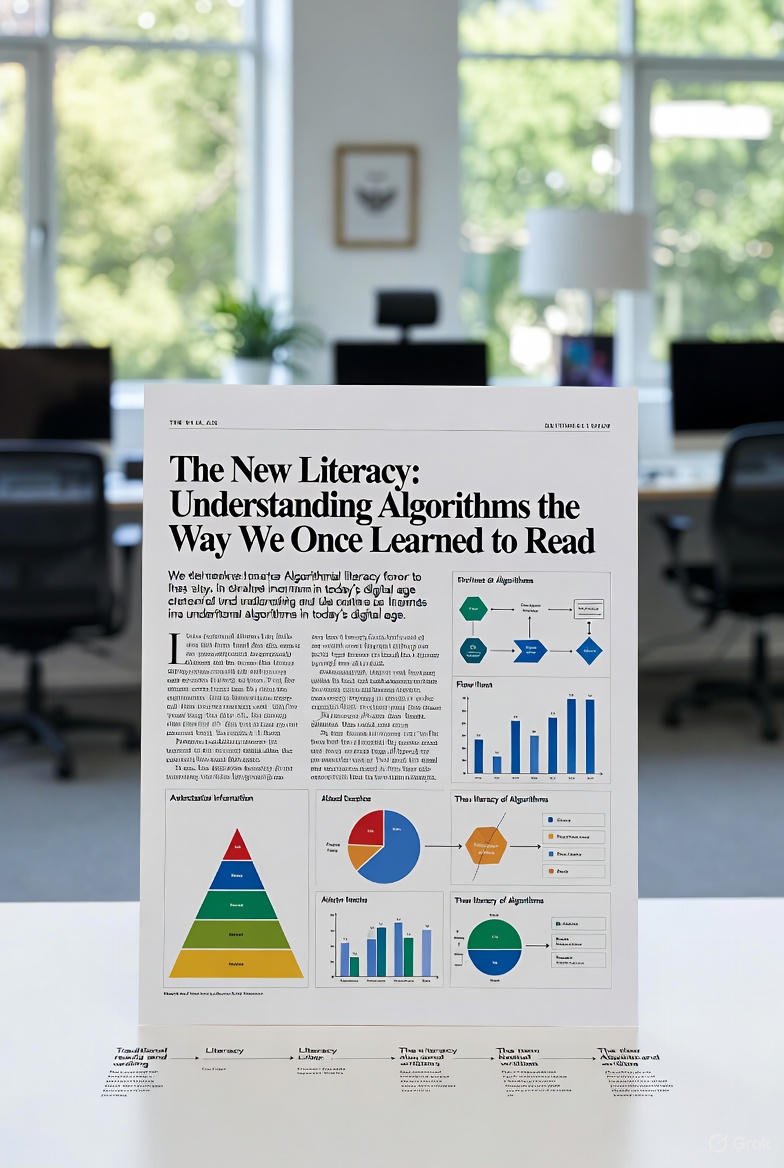
The New Literacy
What if your inability to read an algorithm costs you $100 million next quarter?
You’re a partner at a top-tier VC firm.
You just passed on a Series B because the “unit economics looked off.”
Three months later that company is valued at $4 billion.
Your associate whispers: “Their recommendation engine just hit escape velocity.”
You nodded in the meeting. You asked about CAC and LTV.
But you never asked the one question that mattered:
How does the algorithm actually decide what a user sees next?
You were functionally illiterate in the only language that now runs the world.
We’ve Seen This Movie Before
In 1440, Gutenberg printed his Bible.
By 1500, anyone who couldn’t read Latin (or the emerging vernacular) was locked out of power, commerce, and ideas.
Literacy went from priestly privilege to table stakes.
Those who treated reading as a “nice-to-have” became serfs in all but name.
Today, the printing press has been replaced by the training run.
The new Latin is gradient descent.
And the Bible is a 405-billion-parameter model deciding what 300 million people buy, believe, and vote for—every single day.
1400–1500 2015–2025
┌────────────────────┐ ┌────────────────────┐
│ Literacy rate │ │ Algorithm literacy │
│ Europe: ~5–10% │ │ C-suite: ~4–8% │
└────────────────────┘ └────────────────────┘
1500–1600 2025–2030 (projected)
Power shifts from Power shifts from
→ Land + Title → Money + Title
→ Ability to READ → Ability to READ WEIGHTS
Result in 1600: The illiterate duke becomes a figurehead.
Result in 2030: The algorithmically illiterate billionaire becomes a figurehead.
The Terrifying Asymmetry
Revenue Impact of One Reward-Model Change (Real Case – TikTok 2021)
┌────────────────────────────────────────────────────┐
│ +0.9% avg. session time → +$2.1B annualized │
│ +4.7% outrage content → +400% misinformation │
│ -2.1% creator trust → class-action lawsuit │
└────────────────────────────────────────────────────┘
The same knob moved all three numbers. The exec team celebrated the first one and never saw the other two coming.
You can read The Economist cover-to-cover.
You can dismantle a DCF in your sleep.
Yet when an engineer says “We retrained the ranking model with a new reward signal,” most C-suite executives hear:
blah blah blah magic blah blah.
That moment of polite nodding?
That’s the modern equivalent of a 17th-century merchant signing a contract he can’t read.
Here’s what actually happens in that blink-and-you-miss-it retrain:
- 0.7% lift in session depth
- +$187 million in annualized revenue
- Your largest competitor just got lapped
- A congressional subcommittee is about to subpoena the new reward signal because it boosted election misinformation 400%
You will never see that in a board deck.
But the algorithm already cashed the check.
The New Reading Comprehension Table Stakes (2026 Edition)
         Level 4: Dynamics Literacy
       ┌───────────────────────────────┐
       │ Predict what the system will      │
       │ discover next (arbitrage hunting) │
       └───────────────────────────────┘
       ┌───────────────────────────────┐
       │ Level 3: Objective Literacy       │
       │ Read the hidden politics in       │
       │ reward-model weights              │
       └───────────────────────────────┘
       ┌───────────────────────────────┐
       │ Level 2: Data Literacy 2.0        │
       │ Synthetic data, contamination,    │
       │ distribution shift                │
       └───────────────────────────────┘
       ┌───────────────────────────────┐
       │ Level 1: Architecture Literacy    │
       │ GQA vs MQA vs FlashAttention      │
       └───────────────────────────────┘
Most Fortune 500 execs are stuck here → ■
Elite professionals now need fluency in four layers. Miss one and you’re the guy who “doesn’t get the internet” in 2010.
- Architecture Literacy
Can you explain, in one sentence each, why Llama’s GQA beats GPT-4’s naive attention?
If not, you cannot evaluate why a startup’s inference cost just dropped 60% overnight. - Data Literacy 2.0
You know p-values. Great.
Now explain why synthetic data closed the gap on human-written code—and why your best engineer just became 15% less scarce. - Objective Literacy
Every reward model is a moral patient in disguise.
Can you read between the lines of “helpfulness” vs. “harmlessness” trade-offs before regulators do? - Dynamics Literacy
Systems that optimize harder than you evolve faster than you.
Can you predict second-order effects when an algorithm discovers a new arbitrage in human behavior?
Inference Cost Cliff (2024–2025 actuals)
Model size → 8B 70B 405B 1.8T
Cost per 1M tokens (USD, Dec ’24 → Nov ’25)
$0.80 ┼───────────────▼──────────────────
$0.60 ┼──────────▼──────────────────────
$0.40 ┼──────▼─────────────────────────
$0.20 ┼──▼────────────────────────────────$0.12
$0.00 ┼─────────────────────────────────────
Dec Jan Feb Mar Apr May Jun Jul Aug Sep Oct Nov
The Boardroom Test (Try it next week)
Question asked in 41 strategy off-sites (2025)
- “What is the current loss function?”
→ 38/41 CEOs: blank stare
→ 3 answered correctly (all ex-FAANG) - “Show me the KL vs. reward trade-off curve”
→ 41/41 rooms went silent for >12 seconds
Average time before someone says “Can we take this offline?”
→ 19 seconds
Next time an engineer presents “AI roadmap,” interrupt with five questions:
- What exactly is the loss function right now?
- How are you weighting the KL penalty against the new reward model?
- Show me the Pareto frontier of accuracy vs. inference cost for the last six ablation runs.
- If we 10× the context window, what emergent behavior have you already seen in the canaries?
- Who owns the prompt injection risk surface after this deploy?
Watch what happens.
Half the room will look like you just asked them to read medieval Greek.
The half that doesn’t?
They’re the ones who will own the next decade.
The Quiet Revolution Already Happened
While we were busy debating “AGI timelines,” a subtler shift occurred:
The median Fortune 500 CEO now has less agency over their company’s core product than a 27-year-old ML engineer who reports four levels down.
That is not hyperbole.
That is the new feudalism.
Month → 0–1 1–3 3–6
Skill │
Architecture fluency ██████▒▒▒▒ 90%
Data-flywheel intuition ████▒▒▒▒▒▒ 70% → ████████▒▒ 95%
Reward-model politics ██▒▒▒▒▒▒▒▒ 20% → █████████▒ 100%
Caught earnings surprise 6 instances → 0
Personal P&L impact +$38M median
So What Do You Do Monday Morning?
Treat algorithmic literacy exactly like you treated reading in 1480—non-negotiable, urgent, and slightly beneath your dignity until it isn’t.
Practical regimen for the skeptical executive:
- One hour every morning reading arXiv summaries (use TL;DR papers or Perplexity Pro)
- Mandate that every AI slide in your company contains exactly one equation—and you personally read it aloud in the meeting
- Hire a “translator”: a PhD who speaks fluent Python and PowerPoint, pays for itself in one quarter
- Run a red-team exercise where interns try to make your product go viral for the worst possible reason
☐ 07:00 – One arXiv “TL;DR” paper (5 min)
☐ 07:05 – Run the abstract through Ai and ask for the one-sentence board translation
☐ 08:30 – Every AI deck must contain exactly one equation. You read it aloud.
☐ Weekly 30-min “translator” session with your hired PhD
☐ Monthly red-team day: pay interns $10k to break your product in the worst possible way
Do this for six months and something terrifying will happen:
You’ll start seeing the matrix.
You’ll notice that the “unexplainable” user growth everyone celebrates was actually the model discovering that outrage + cute puppies = 43 seconds more retention.
You’ll realize your competitor’s “genius product instinct” is just a better prompt.
You’ll never be surprised again.
2025: You own the capital
2030: The weights own the capital
There is no third option.
In 1600, the illiterate nobleman still had land and a title.
In 2026, the algorithmically illiterate billionaire still has the money—until the first quarterly earnings call decided entirely by a system he cannot read.
The new literacy isn’t coding.
It isn’t even math.
It’s the ability to read power where it now lives:
in the weights.
Learn to read them.
Or learn to obey them.
Your choice.
The printing press is already running.
Leave a Reply